
Marco Rubio will visit Mumbai and Jamnagar to discuss energy cooperation as S Jaishankar says India-US trade talks are nearing a landing point, with a few issues unresolved.
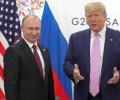
Former President Donald Trump's recent deal with Russia to supply diesel to the US and global markets has ignited a political firestorm, drawing sharp criticism from Ukraine's President Volodymyr Zelenskyy, Democratic leaders, and a segment of Republicans, despite the US Treasury lifting sanctions on Russian diesel supplies.

Discover the top OTT releases this week, featuring a compelling mix of Hindi dramas like Imtiaz Ali's Main Vaapas Aaunga and Manoj Bajpayee's Governor, alongside regional and international titles.

Iranian President Masoud Pezeshkian urged BRICS nations to expand trade in national currencies and build an inclusive global economic framework. He criticised "unilateral sanctions" by Western powers, stating they make emerging economies vulnerable and impact global food security. Pezeshkian emphasised BRICS' role in creating a balanced world order and highlighted Iran's geopolitical and energy capacities for cooperation.

'After announcing that she will return to Bangladesh, if she does not, her credibility will suffer.'

'This is what we train for: That one chance to deliver a blow so lethal that the enemy will constantly think about it when planning any misadventure.'

Maharashtra Navnirman Sena (MNS) chief Raj Thackeray has voiced strong concerns about the divisive role of social media in society, alleging it fuels anger and religious disputes. He also criticised the unbridled use of high-decibel sound systems, questioned the government's economic policies despite GDP growth claims, and objected to political messaging in public offices. Thackeray further addressed linguistic politics and endorsed the "Inquilab Zindabad" slogan.
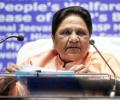
The Bahujan Samaj Party (BSP) has appointed Ishan Anand, Mayawati's younger nephew, as its new national coordinator. This decision follows the removal of his elder brother, Akash Anand, from all party responsibilities. The appointment was made at a national executive meeting, where Mayawati reiterated the party's commitment to avoiding dynastic politics.

Why the industry's public position changed is difficult to say. What the developments did establish, though, is that ethanol-blended petrol has become one of the country's most politically and commercially sensitive policy issues.

Bangladesh-China and Bangladesh-US relations have evolved from reluctant engagement to increasingly consequential strategic partnerships.

The question for the next 20 years is not whether India can become a $5 trillion or $10 trillion economy. Those are attractive targets, but the real question is whether India can create enough productive jobs, educate its children properly, make its cities liveable, and give hundreds of millions of people a substantially better life, asserts Ramesh Menon.

Tamil Nadu Chief Minister C Joseph Vijay issued a stern warning against personal attacks, double-meaning insults, and derogatory language targeting women, particularly in political discourse. Speaking in the Assembly, he recalled past humiliations faced by late CM J Jayalalithaa and condemned recent incidents involving women personalities, stressing that such behaviour would face immediate legal consequences. He also outlined his administration's vision for public security and zero-tolerance against crime.

CPI(ML) Liberation general secretary Dipankar Bhattacharya has strongly criticised the newly introduced Merchant Discount Rate (MDR) on select UPI transactions, labelling it a "UPI tax" and demanding its immediate rollback. He drew parallels with demonetisation, arguing that the new framework would negatively impact small shopkeepers, MSMEs, and ordinary citizens by increasing prices.

'The way the government behaves, sometimes I ask myself: Are not Tamils Sri Lankans too? Why do you discriminate so much?'

West Bengal Chief Minister Suvendu Adhikari outlined his government's priorities, focusing on strengthening the state's economy, attracting investment to create jobs, and improving law and order. He criticised the previous administration for alleged corruption and appeasement politics, while highlighting initial successes in border management and reducing criminal activities.

Prime Minister Narendra Modi and Russian President Vladimir Putin held extensive discussions to strengthen bilateral trade, defence, and energy cooperation, while also addressing the ongoing Ukraine conflict and exploring avenues for peace and resolution, with Modi reiterating India's call for dialogue and diplomacy.

The 2026 election appears to have reinforced a new political formula in Assam: Strong organisation, continuous grassroots engagement, effective alliance management and welfare-based voter outreach.

Southern chief ministers fear population stabilisation could reduce their parliamentary representation and tax devolution benefits.

Prime Minister Narendra Modi urged Russian President Vladimir Putin to move from 'endless war to the end of war' in Ukraine, emphasising that a peaceful resolution is humanity's shared priority.

India is currently examining Bangladesh's request for the extradition of former prime minister Sheikh Hasina, who has been living in India since her government's collapse in August 2024, with New Delhi confirming the issue is being processed according to established procedures.

The Hingorani family's decision to part with the Gandhi archive after generations was guided by a desire to make it accessible to a wider audience and to fund initiatives that would extend its legacy.

Vande Mataram, the national song that has stirred passions and political controversies for more than a century, received legal protection on Thursday with Parliament passing a bill making any insult to it a punishable offence, rekindling the long-running debate over its place in India's history and identity.

'Some people may not like what I am saying, but shortcomings have to be pointed out. These deficiencies should be rectified within the next three months.' 'This is Gorakhpur, where our CM himself resides. If such shortcomings exist here, then what will happen?'

'When we start describing somebody as an enemy that is the start of politics and emotion after which no business can take place.' 'We need to get out of this, allow Indian businessmen to do business with China.'

Andy Burnham has officially taken office as the new UK Prime Minister, pledging to make politics more about problem-solving and usher in a 'circuit breaker' moment for the country with significant political and economic changes.

The Congress escalated its campaign against alleged examination irregularities by marching to Prime Minister Narendra Modi's residence, transforming the issue into a direct challenge to his political authority and demanding the resignations of top government officials.

US President Donald Trump will visit China from May 13 to 15 at the invitation of President Xi Jinping. The visit occurs amidst global tensions, including the war in West Asia and trade disputes between the US and China. Discussions are expected to cover China-US relations, world peace, and economic issues.

Prime Minister Narendra Modi on Thursday discussed with a group of senior ministers the prevailing global security situation and how to maintain supply chain uninterrupted despite conflicts in different zones, including the Strait of Hormuz, the Black Sea, the Red Sea, and the Gulf of Aden.

Every day, the older men running our politics keep pushing Gen Z voters further away, observes Binu Alex.

'If you read the TVK manifesto, it is doles and much more doles. But the state has been habituated to this.' 'In no way is he distinct or different from the DMK regime.'

FIFA President Gianni Infantino's ambitious plan to sell a 20% stake in a commercial entity managing the World Cup and other tournaments to private investors has been abandoned following widespread opposition, including a boycott threat from UEFA.

West Bengal has enacted two controversial legislations, the Public Safety and Control of Anti-Social Activities Act and the Maintenance of Public Order (Amendment) Act, aimed at curbing organised crime and violent protests. These laws grant authorities significant powers, including preventive detention without trial and property attachment for riot damages, drawing both support and criticism.
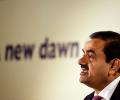
A US federal judge has permanently dismissed the criminal securities-fraud case against Adani Group chairman Gautam Adani and his nephew Sagar, closing nearly two years of prosecution without a trial. Gautam Adani stated, "Truth has prevailed," in response to the ruling.

'We can integrate AI and tech into education, but that is just a means and not an end.' 'Ultimately, we need to control what happens in a classroom and we need to let teachers innovate their teaching style to suit the needs of Gen Z and beyond.'

'The Ayodhya incident has certainly hurt the faith of all of us, of Ram devotees like us.'

Sourabh Chandrakar, the absconding founder of the Mahadev betting app, has been detained in Oman based on an Interpol Red Notice. Indian agencies are now working to extradite or deport him. The ED's investigation into the syndicate has revealed alleged proceeds of crime worth Rs 6,000 crore and links to high-ranking politicians and bureaucrats.

It is plain to see that the US senate bill's real objective is to derail India's time-tested strategic partnership with Russia, points out Ambassador M K Bhadrakumar.

The Dhurandhar movies will undoubtedly shape the minds of the audience much more than news reports, court investigations, books and documentaries. But it is worth remembering that Pakistan's irridentist claims against India's national security have succeeded due to strategic planning, diplomacy, and the unsung heroines and heroes across government agencies, not due to a single maverick leader, points out Shweta Desai.But it is worth to remember that Pakistan's irredentist claims against India's national security have succeeded due to strategic planning, diplomacy, and the unsung heroines and heroes across government agencies -- not a single maverick, points out Shweta Desai.

In the throes of a financial crisis, the state's ruling Congress government has little to be triumphant about as Assembly elections approach next year, points out Aditi Phadnis.

As MGNREGA comes to a close, both critics and supporters keenly eye VB G RAM G's performance.
